
Disclaimer: This article is intended solely for informational and educational purposes only. It does not constitute medical advice.
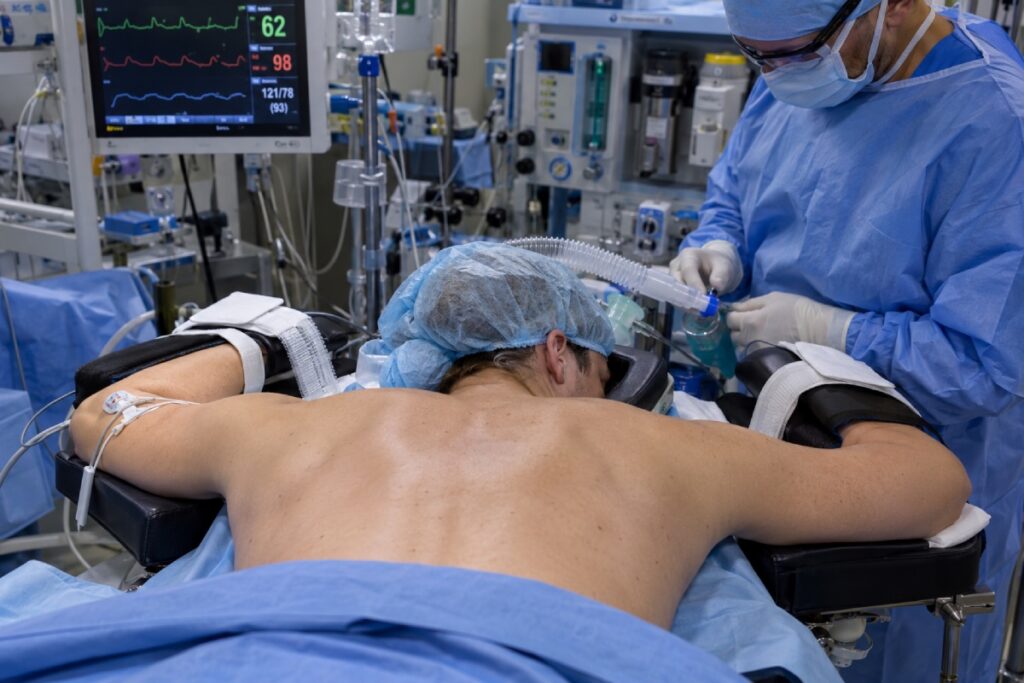
Prone intubation is an uncommon airway technique in which tracheal intubation is performed with the patient positioned prone rather than supine. Although most anesthesiologists are trained to secure the airway before turning a patient prone, certain clinical circumstances may make prone airway management advantageous. This is particularly relevant in patients with severe hypoxemic respiratory failure who deteriorate while already prone, as well as selected patients undergoing posterior spinal or other procedures in whom turning supine may be difficult or hazardous. Elective induction in the prone position has also been described, although available evidence remains limited and does not support routine use.
The most important consideration during prone intubation is maintaining oxygenation while establishing a definitive airway. When feasible, preoxygenation should be optimized before induction, with high-flow nasal oxygen or noninvasive ventilation considered in patients with significant hypoxemia. Positioning should provide adequate access to the head and airway while maintaining spinal precautions when indicated. A video laryngoscope may be particularly useful because it can provide indirect visualization without requiring the same degree of operator positioning as direct laryngoscopy. Flexible bronchoscopy is another option, particularly when cervical mobility is restricted or a difficult airway is anticipated. Importantly, a clear rescue strategy should be established before induction because conventional airway maneuvers are considerably more challenging in the prone position.
In patients who are already prone and require urgent airway control, the decision to intubate prone or to turn them supine must balance the difficulty and potential risks of the turn against the difficulty of securing the airway in the existing position. For patients with severe hypoxemia, even a brief interruption in oxygenation during repositioning may be poorly tolerated. Conversely, prone intubation may limit access to the airway and make management of hemodynamic collapse more difficult. If prone intubation is attempted, maintaining spontaneous ventilation until the airway is adequately secured may be preferable in selected high-risk patients, particularly when loss of airway control following induction would be difficult to rescue. Awake intubation principles—including effective topical airway anesthesia, minimal sedation, continuous oxygen delivery, and confirmation of tracheal placement before induction—may be applicable when a difficult airway is anticipated.
Supraglottic airway devices represent an important rescue option if tracheal intubation is unsuccessful or an unanticipated extubation occurs while the patient is prone. Published reports describe successful insertion of supraglottic devices in the prone position, although most available evidence consists of case reports and observational series. In one review of 526 patients, first-attempt insertion success ranged from 87.5% to 100%, with successful ventilation reported in 83.3% to 100% of patients. These data support familiarity with prone supraglottic airway placement as a rescue technique but do not establish it as a substitute for definitive tracheal intubation.
Prone intubation should therefore be viewed as a specialized airway skill rather than a routine alternative to supine intubation. The technique may be particularly valuable when severe hypoxemia makes repositioning unsafe or when access to the airway is unexpectedly required during prone surgery. Successful management depends less on a single preferred device than on preparation, preservation of oxygenation, appropriate patient selection, and a rehearsed rescue plan. Given the limited evidence base, elective prone induction should remain reserved for carefully selected circumstances and experienced teams, while anesthesiologists caring for patients undergoing prolonged prone procedures should maintain competency in both prone airway rescue and rapid repositioning when necessary.
References
- Edgcombe H, Carter K, Yarrow S. Anaesthesia in the prone position. Br J Anaesth. 2008;100(2):165-183. DOI: 10.1093/bja/aem380
- Schmittner MD, Vajda E, Kloesel B, et al. Should we induce general anesthesia in the prone position? Curr Opin Anaesthesiol. 2014;27(6):635-640. DOI: 10.1097/ACO.0000000000000123
- Pavlov I, et al. Awake prone positioning in non-intubated patients with acute hypoxemic respiratory failure due to COVID-19. Respir Care. 2022;67(1):102-114. DOI: 10.4187/respcare.09191
- Tolia Chilkoti G, Mohta M, Ahmad Z, Saxena AK. Awake prone-positioning in patients on non-invasive ventilation for management of SARS-CoV-2 pneumonia: a systematic review. Anesth Res Pract. 2022;2022:1-11. DOI: 10.3390/arm90040046