
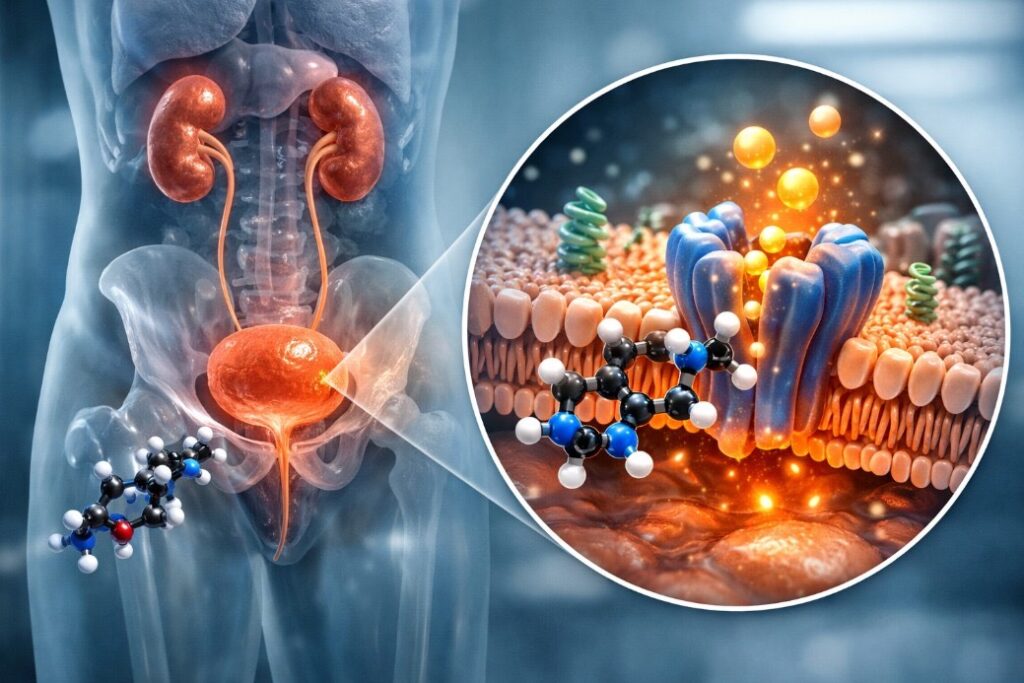
For decades, ketamine has been used as an anesthetic agent, but more recently, it has also been employed in carefully supervised treatments for treatment-resistant depression. However, outside medical settings, ketamine is sometimes misused as a recreational drug. Repeated or high-dose exposure can have serious urological effects—a problem now widely known as ketamine-associated uropathy or ketamine cystitis.
The urinary tract includes the kidneys, ureters, bladder, and urethra. These organs store and remove waste from the body in the form of urine. Ketamine and its breakdown products are partly eliminated through urine, which means the lining of the bladder is directly exposed to the chemical. Research suggests that ketamine can irritate and inflame this lining, damaging the protective layer of cells that normally prevents urine from harming deeper tissues. Over time, this irritation can trigger chronic inflammation and scarring 1–4.
One of the earliest symptoms of ketamine-associated uropathy reported by users is increased urinary frequency. People may feel the need to urinate every 10–15 minutes, even when the bladder is nearly empty. This is often accompanied by urgency, a sudden and uncomfortable pressure to pass urine. Pain or burning during urination, known as dysuria, is also common. Some individuals notice blood in the urine or a cloudy appearance—signs that the bladder wall has become inflamed.
As damage progresses, the bladder can lose its ability to stretch and hold normal volumes of urine, resulting in a reduced bladder capacity. This leads to constant discomfort and frequent nighttime waking to use the bathroom, which greatly affects the quality of one’s sleep and daily life.
Ketamine’s urological effects are not limited to the bladder. Imaging studies have shown that long-term exposure can cause swelling or narrowing of the ureters, the tubes that carry urine from the kidneys to the bladder. When urine cannot drain properly, pressure builds up in the kidneys, a condition called hydronephrosis. If untreated, this can gradually reduce kidney function and, in extreme cases, lead to kidney failure.
The exact reason ketamine causes these problems is still being studied. Scientists believe several mechanisms are involved: direct toxic effects of ketamine metabolites, reduced blood supply to bladder tissues, and abnormal nerve signaling that makes the bladder overly sensitive. Infections may develop on top of this damage, making symptoms worse 5–7.
Treatment of these effects first focuses on stopping ketamine exposure. Many patients experiencing urological symptoms due to regular ketamine use observe improvement within months after quitting, especially if the condition is caught early. Doctors may prescribe anti-inflammatory medicines, bladder-relaxing drugs, or physical therapy to ease symptoms. Severe cases sometimes require surgical procedures to enlarge or reconstruct the bladder, highlighting how serious the condition can become 8–11. Patients who have experienced complications as a result of ketamine medical or recreational use should inform their doctors, especially if they need to receive anesthesia for a procedure.
References
1. Srirangam, S. & Mercer, J. Ketamine bladder syndrome: an important differential diagnosis when assessing a patient with persistent lower urinary tract symptoms. BMJ Case Rep 2012, bcr2012006447 (2012). DOI: 10.1136/bcr-2012-006447
2. Rosenbaum, S. B., Gupta, V., Patel, P. & Palacios, J. L. Ketamine. in StatPearls (StatPearls Publishing, Treasure Island (FL), 2025).
3. Ketamine – More mechanisms of action than just NMDA blockade. Trends in Anaesthesia and Critical Care 4, 76–81 (2014).
4. Baetens, E. et al. Ketamine-Induced Uropathy: The Detrimental Effects of Chronic Ketamine Abuse Beyond the Bladder-A Case Report with a Brief Literature Review. Journal of Urological Surgery https://doi.org/10.4274/jus.galenos.2024.2024-3-13 (2024). DOI: 10.4274/jus.galenos.2024.2024-3-13.
5. Chan, E. O. T. et al. Systematic review and meta-analysis of ketamine-associated uropathy. Hong Kong Med J 28, 466–474 (2022). DOI: 10.12809/hkmj209194
6. Lamers, G. et al. Ketamine-induced uropathy: A diagnostic pitfall in an increasing healthcare issue in youngsters. Urol Case Rep 42, 102019 (2022). 6. Lamers, G. et al. Ketamine-induced uropathy: A diagnostic pitfall in an increasing healthcare issue in youngsters. Urol Case Rep 42, 102019 (2022).
7. Kuo, H.-C. Ketamine-induced uropathy. Continence 15, 101907 (2025). DOI: 10.1016/j.cont.2025.101907
8. Zhou, J., Scott, C., Miab, Z. R. & Lehmann, C. Current approaches for the treatment of ketamine-induced cystitis. Neurourology and Urodynamics 42, 680–689 (2023). DOI: 10.1002/nau.25148
9. Jhang, J.-F., Birder, L. A. & Kuo, H.-C. Pathophysiology, clinical presentation, and management of ketamine-induced cystitis. Tzu Chi Med J 35, 205–212 (2023). DOI: 10.4103/tcmj.tcmj_94_23
10. Betancur, J. F. et al. Ketamine-induced cystitis: A case report and literature review. Radiology Case Reports 19, 5724–5728 (2024). DOI: 10.1016/j.radcr.2024.08.053
11. Ou, Y.-L., Liu, C.-Y., Cha, T.-L., Wu, S.-T. & Tsao, C.-W. Complete reversal of the clinical symptoms and image morphology of ketamine cystitis after intravesical hyaluronic acid instillation: A case report. Medicine 97, e11500 (2018). DOI: 10.1097/MD.0000000000011500